Why This Comparison Matters in 2026
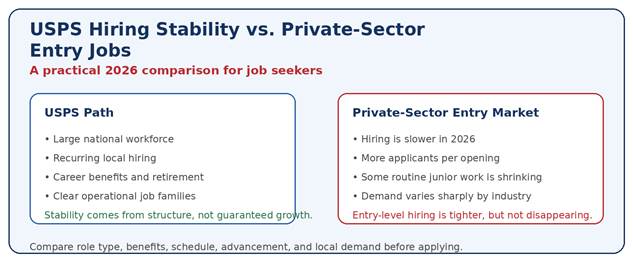
Entry-level job seekers are facing a slower U.S. labor market. LinkedIn's July 2026 Workforce Report found national hiring was 7.5% lower in June 2026 than a year earlier. New graduates and early-career applicants are also competing for fewer openings in several professional and administrative fields. That does not mean private-sector entry jobs are disappearing, but it does mean many applicants face longer searches and more competition.
USPS presents a different employment model. The Postal Service operates a large national delivery and logistics network that needs carriers, clerks, mail handlers, maintenance workers, drivers, supervisors, and technical staff across thousands of locations. Its hiring needs rise and fall by region, season, turnover, retirements, and operational changes, but local vacancies continue to appear throughout the year.
Is USPS Employment More Stable Than a Typical Entry-Level Private Job?
For many workers, USPS employment can offer more structure than a short-term or lightly benefited private-sector entry role. Career postal positions may include health coverage, retirement benefits, paid leave, scheduled pay progression, union representation for many bargaining-unit jobs, and internal advancement opportunities.
Stability does not mean every postal position is permanent from day one. City Carrier Assistant, Rural Carrier Associate, Mail Handler Assistant, and Postal Support Employee roles may begin as pre-career or noncareer appointments. Schedules can be demanding, overtime may be frequent, and conversion to career status depends on the position, local staffing, contracts, and available vacancies.
The USPS Workforce Is Large, but It Is Not Simply Growing Every Year
USPS reported about 624,000 total employees in fiscal year 2025, including more than 531,000 career employees. The total workforce was lower than in fiscal year 2024, while the number of career employees declined only slightly. Pre-career employment fell more sharply.
Those figures matter because they show the difference between workforce stability and nonstop expansion. USPS still replaces retirees, fills local shortages, converts employees, and recruits for hard-to-staff offices, even while the organization adjusts staffing and operations.
Why Private-Sector Entry Hiring Feels Harder
Private-sector hiring has cooled across many industries. Employers are taking longer to approve openings, combining responsibilities, and asking for more experience in roles that were once designed for beginners. In some office-based fields, automation and generative AI are also reducing the amount of routine junior work assigned to new employees.
The effect is not equal everywhere. Health care, skilled trades, logistics, hospitality, construction, and field services may still have strong entry-level demand in certain markets. The greatest pressure is often seen in crowded professional, administrative, technology, and remote-friendly job categories.
Where Postal Jobs Have an Advantage
- Essential service demand. Mail and package delivery requires a physical workforce in every state.
- Large geographic footprint. Applicants can search across cities, suburbs, and rural areas instead of relying on one corporate office.
- Defined job families. Carrier, clerk, mail handler, maintenance, and driving roles have clear operational responsibilities.
- Career benefit structure. Eligible career employees receive retirement, health, leave, and savings benefits that many entry-level private jobs do not match.
- Internal mobility. Career employees may move into supervision, maintenance, logistics, HR, IT, finance, safety, and other functions over time.
Applicants interested in indoor sorting and processing work can review a Postal Mail Processing Clerk opening to understand how duties, schedules, physical requirements, and location affect the job. Processing positions often involve standing, moving containers, scanning, sorting, and working shifts tied to mail volume.
Where Private-Sector Entry Jobs Still Have an Advantage
USPS is not automatically the better choice for every applicant. Private employers may offer remote or hybrid work, faster promotion in growing companies, performance bonuses, flexible schedules, specialized training, or easier movement between industries.
A private-sector role may also fit applicants who want office-based work, technology exposure, sales experience, or a faster route into a specific profession. The right comparison is not USPS versus every private employer. It is one real postal opening versus one real private-sector offer.
City Carrier Assistant: Stability With a Demanding Start
City Carrier Assistant roles attract applicants because they provide a direct route into postal delivery work. The job can also be physically demanding. CCAs may walk long routes, carry mail and parcels, work outdoors in difficult weather, and accept schedules that change with staffing needs.
A current Postal City Carrier Assistant listing gives applicants a practical way to compare the role with warehouse, retail, delivery, or other local entry-level work. Look beyond the hourly rate and consider route demands, overtime, benefits, commute, and the possibility of conversion to career status.
A Better Way to Compare Job Stability
|
Factor |
USPS Entry Path |
Typical Private-Sector Entry Role |
|
Employer scale |
Large national network |
Ranges from small businesses to global companies |
|
Entry requirements |
Often no four-year degree for operational roles |
Varies widely, with some employers raising experience requirements |
|
Benefits |
Strongest after career appointment |
Ranges from minimal to excellent |
|
Schedule |
Often fixed by operations and may include weekends or overtime |
May offer more flexibility depending on industry |
|
Advancement |
Structured internal paths and career conversions |
Potentially faster in high-growth companies |
|
Job security |
Supported by essential-service demand, but staffing still changes |
Depends heavily on company, industry, funding, and demand |
What Current Hiring Data Suggests
The broader U.S. hiring market remains soft. LinkedIn reported June 2026 national hiring at 7.5% below June 2025, and its research on new graduates describes a more competitive entry market with more applicants per posting than several years ago.
At the same time, USPS continued announcing local job fairs and immediate vacancies during summer 2026 in states including Texas, Pennsylvania, Virginia, Idaho, Maryland, Oklahoma, Ohio, and California. This pattern supports the idea that postal hiring remains active even while the overall job market is slower.
How to Decide Whether a Postal Job Is Right for You
- Choose USPS if you value structured benefits, physical work, public-service operations, and a long-term career path.
- Choose a private-sector role if it offers stronger skill development, better flexibility, higher upside, or a clearer route into your target profession.
- Compare total compensation, not only the starting wage.
- Check whether the postal role is career or pre-career.
- Consider schedule stability, commute, overtime, physical demands, and advancement potential.
- Apply to several suitable jobs rather than waiting for one employer.
Job seekers who want to compare a wider range of Postal Jobs should review each employer and posting carefully. Different listings may represent different appointment types, schedules, locations, and benefit structures.
External Labor-Market Reference
For current U.S. hiring trends, review LinkedIn Economic Graph's July 2026 U.S. Workforce Report. The report shows national hiring was lower both month over month and year over year in June 2026, providing useful context for today's more competitive entry-level market.
Frequently Asked Questions
Is USPS employment guaranteed to be more stable than a private-sector job?
No. Stability depends on appointment type, location, performance, staffing needs, and the specific private employer being compared. Career postal employment often offers stronger structural protections and benefits than many entry-level roles, but no job is risk-free.
Are USPS jobs increasing in number every year?
No. USPS total employment declined in fiscal year 2025 compared with 2024. The organization still hires continuously because of turnover, retirements, local shortages, conversions, and operational needs.
Why are private-sector entry jobs harder to get in 2026?
Overall hiring is slower, competition is higher, and some employers are asking junior candidates to bring more experience. Automation and AI are also changing certain routine office tasks.
Do you need a college degree for most entry-level USPS jobs?
Many operational roles do not require a four-year degree. Applicants still need to meet age, eligibility, assessment, driving, background, and job-specific requirements.
Are City Carrier Assistant jobs career positions?
CCA roles are commonly pre-career positions. They may provide a route to career appointment depending on contract rules, local vacancies, and time in service.
Do postal workers receive retirement benefits?
Eligible career postal employees participate in federal retirement programs and may receive access to the Thrift Savings Plan, health coverage, paid leave, and other benefits.
Is USPS a good option for someone laid off from retail or warehouse work?
It may be. Skills such as reliability, customer service, safe lifting, route discipline, attendance, and working under time pressure transfer well to many postal roles.
Should I stop applying elsewhere after submitting a USPS application?
No. Postal hiring can take several weeks or longer. Continue applying to suitable opportunities until you receive a confirmed offer and start date.
Final Takeaway
USPS offers a different kind of entry path from many private employers. Its advantage comes from a large national network, recurring operational hiring, structured career benefits, and internal advancement. The tradeoff is demanding schedules, physical work, slower hiring processes, and the fact that many entry roles begin as pre-career appointments.
In a 2026 labor market where overall hiring is weaker and entry-level competition is high, postal work deserves consideration. Compare the exact role, employment status, benefits, schedule, and long-term path before deciding which opportunity offers the strongest stability for you.